Strength: Getting Started
_1st_%2C_KAKOUSIS_Perikl.jpg)
One of the biggest problems I see people have when they’re starting out at the gym is literally just not knowing what the heck to do. The purpose of this article is to prevent this situation.
Something I’ve seen a lot at work is that newcomers come in, and they look around the weight room, and they’re clearly just kinda lost; they’ll pick up a dumbbell and do some curls until they get tired, and then they’ll think, “oh, I should do something for legs” and they’ll go on the leg press until someone else seems to want it, and then they’ll try a few other things and leave. And they usually won’t last more than a couple weeks, if that, because they feel like they’re not really doing anything- because they aren’t.
I’ve written this a whole lot, but there is no one sized fits all training program. But between this article and the “Strength 101” article, you should be able to get an idea of what you are looking for, and some sense of a roadmap on how to do it.
To begin at the beginning: there are five basic disciplines/phases/types of strength training- adaptation, strength, endurance, hypertrophy, and power. These were briefly covered in the “Strength 101” article, and I’ll probably go into more detail on each in later articles. The bottom line for now is that which of these you are doing will dictate what kind of weight you’re lifting, how many times you’re lifting them, and how often you’re doing it.
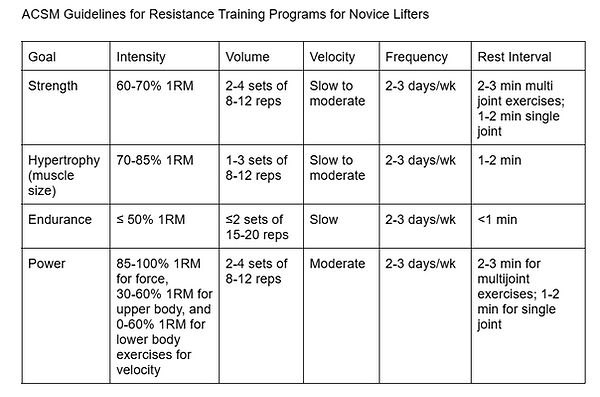
And if you’re reading this, you’re probably in the “adaptation” phase. It is where everyone starts; it’s getting your body used to this kind of exercise, and you risk plateau at best and injury at worst if you just skip it. Most people are going to be in this phase for about a couple months, often longer, depending on their goals, nutrition, individual physiological factors (such as training history, disabilities, etc) and how much they’re actually sticking to their program.
During this phase, if you are consistent and your nutrition is halfway decent, you will see rapid improvement. This is the “newb gains” a lot of people talk about. It is important to remember to not be discouraged when your progress inevitably slows down- you’re not necessarily doing anything wrong. In fact, you’re becoming more advanced, and are likely ready to move on to another stage.
So- knowing you’re in “adaptation” how much should you be lifting, how many times should you be lifting it, and how often should you be doing it?
The answer to all these questions comes in the form of the following specs:
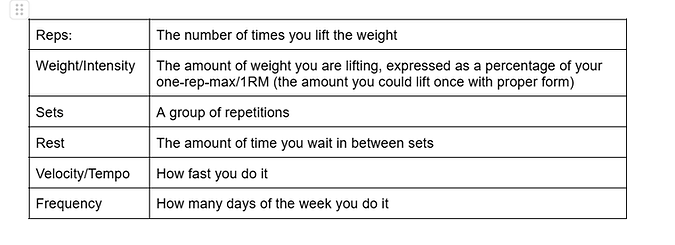
Here is what I recommend for MOST healthy beginners:

Here is how to do this:
-
Select the weight that you can lift 8 times WITH GOOD FORM. Do that, then rest for 60 seconds, then repeat two more times.
-
Then, the next time you work out, you are going to try to lift that same weight nine times. Go on like this until you get to 12. (If you are new to weightlifting, it is likely you’ll be able to improve by more than one rep per workout at first, and may be able to increase the weight ahead of schedule).
-
Once you reach 12 repetitions, on your next workout, you are going to select a sightly heavier weight, and go back down to eight repetitions.
-
Also, if you’re doing cardio at the gym too, do strength first.
FAQs
-
Shouldn’t I be going to failure?
-
No. Doing this repeatedly will only exhaust your muscles completely every time, and this is not conducive to growth
-
Is the rest really all that important?
-
Yes. Strength gains don’t actually happen while you are lifting; they happen while you are recovering.
-
Can I work out more than three times a week?
-
It is best if you only lift weights three times a week in the beginning. You can do other types of workout in addition to this. Watch for signs of over training if you’re doing a lot.
-
I’m very sore, is this normal?
-
Delayed onset muscle soreness (DOMS) is normal at first. It usually stops happening within a few weeks. If it is bad enough that you need an extra rest day, just take one. If there is sharp pain, make sure you’re not injured before continuing.
-
I missed two weeks, how much progress have I lost?
-
Unless you literally just started, you probably have not lost any progress. It takes upwards of two weeks (or longer, if you are using your muscles in that time) to really start to lose progress.
-
Should I cut or bulk?
-
If you’re just beginning, and are not overweight or underweight, my most general advice would be to just wait. At this phase, you will experience some “recomposition”- your muscle mass will increase without you having to put on weight. Aka your body composition will change. The rule of thumb is that you’ll be able to maximize this for six months to a year, if you’re doing everything right.
-
If you’re a beginner who has significantly more body fat than you want, you’re *probably* going to find it worthwhile to keep losing weight, because at this phase, it is possible to build muscle while losing fat. You will find this easier if you are not in an extreme caloric deficit, however.
-
Is it true that doing cardio is bad for gains?
-
No. If you are eating enough and not over training cardio, it will not negatively affect your strength. Some advanced athletes will stop doing cardio during some parts of their training cycle.
-
Do I need protein supplements?
-
Short answer: No. Long answer: many people find protein supplements to be an easy and appealing way to hit their daily protein goal. Protein powder can be especially good to cook with, as you can mix it into sweet foods like milkshakes, baking, etc. It’s oversold and can definitely be overpriced, but it is useful.
-
Additional long answer: You’re also gonna want extra fiber. Possibly a lot of it.
-
What about creatine?
-
If you’re at this phase, you don’t need it.
-
Do I need pre workout?
-
Short answer: No. Long answer: There’ll often be a whole bunch of fancy sounding stuff on the label, but it’s basically just an energy drink in powder form. It’s pricey, but definitely a lot more economical than buying actual energy drinks. Of course, under ideal circumstances one should not need to use something like this, but who the hell consistently trains under ideal circumstances? If you choose to use it, be aware that it’s notoriously easy to overuse.
-
I’m under 16, should I do this?
-
Yes, but check in with a professional before you progress beyond adaptation specs.
-
I’m over 30, will this still work?
-
Lol, yes.
-
I’m over 50, will this still work?
-
Yes.
-
I’m over 70, will this still work?
-
Yes, but if you’re a total beginner, I strongly recommend you begin with a trainer or at least an experienced buddy.
-
I have a health condition that I’m concerned about
-
This link leads to a copy of the “Get Active Questionnaire”, which is what certified trainers use to screen for health conditions in Canada. If it indicates that you would be referred out to a physician/other professional due to your condition, you may as well consult with said professional first.
Citations
Clark, Micheal, et al. NASM Essentials of Personal Fitness Training. Burlington, Ma, Jones & Bartlett Learning, 2014.
Heyward, Vivian H. Advanced Fitness Assessment Exercise Prescription. Champaign, Ill. Human Kinetics, 2010.
Ratamess, Nicholas. ACSM’s Foundations of Strength Training and Conditioning. Lippincott Williams & Wilkins, 15 Mar. 2021.