Strength 101
What is strength training?
Strength training is also called “resistance training”. It’s basically anything where you are making your muscles contract in reaction to an external force. This causes your muscles to adapt and be better at doing it. This can mean anything from lifting weights to doing bodyweight exercises.
In addition to there being many different types of it, there’s also many different training methods that can be applied depending on your goals. For instance, say you’re lifting weights- you don’t go about it the same way if you want to train for endurance vs if you want to bodybuild.
This is a huge topic that a lot of people have a lot of opinions about. I’m going to do my best to resist digressing into that and just give a rundown of the most important basic stuff.
What are the benefits of strength training?
No matter who you are, strength training will noticeably improve your life if done properly. It will improve your cardio, your hormone and lipid levels, and is one of the few ways in which it’s actually possible to “speed up your metabolism” without direct medical intervention. (By increasing your muscle/fat ratio).
Strength training improves your bone density. This is the biggest one that a lot of people don’t know. If you’ve wondered why doctors have relatively recently begun recommending that post menopausal women start lifting weights- this is why.
-Strength training will make you more capable of doing physical tasks in your everyday life. The older you get, the more valuable this is. (Even extremely elderly and frail people are able to improve their quality of life and independence by doing an appropriate amount of strength training).
Strength training will make you better at pretty much any sport. Of course, you must align the method to the sport- you probably don’t want to get into powerlifting if you’re a sprinter, for instance.
Strength training can make you hotter pretty much no matter what your aesthetic is. (Once again, it is of course necessary to pick the right type of strength training for what you want to look like.)
Types/Phases of Strength Training
This post would be a doorstopper sized book if I attempted to describe in detail all the different methods of strength training, from classic free weights, to bodyweight training, to direct functional sport related training, to just getting the right construction job. So I’m going to talk about basic strategy instead.
No matter what you’re doing, the foundational principle of strength training is Progressive Overload- that is, the gradual increase of stress on the body, in manageable enough increments that the body adapts instead of breaking down.
If you’re intermediate/advanced, your body does this by increasing the density and/or size of your muscles. If you’re a beginner, your body mostly does this by improving the rate at which your neurons make your muscles contract.
Fun fact: the first documentation of progressive overload was the training plan of Ancient Greek Olympic wrestler Milo of Croton, who (so the story goes) would carry a newborn calf on his back every day between Olympic games. By the time the games rolled around, he’d be carrying a four year old bull on his back- apparently directly into the stadium, where he’d kill and cook it on the spot. This would also go down in history as the first documented instance of auramaxxing in sport.
An additional foundational principle of strength training is the Principle of Specificity, or the SAID (specific adaptation to imposed demands). It’s what it sounds like- the body adapts to the specific demands you make of it.
So, if you lift relatively light weights a whole bunch of times, you get good at lifting a relatively light weight a whole bunch of times, aka you build endurance. If you lift heavier weights consistently, your level of maximal strength will increase. And so on.
Different types of muscle fibers need to be built up and worked on in different ways before they can handle more intense training. This is why you hear about people doing different specs- different numbers of sets, reps, weights, and so on. Changing up these things causes different physical and neurological adaptations. (If you don’t know what I’m on about, you can [click here] or wait until a bit later in the post, where I’ll explain further.)
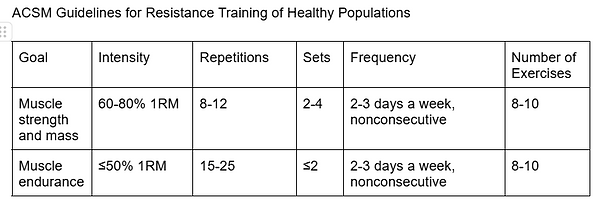
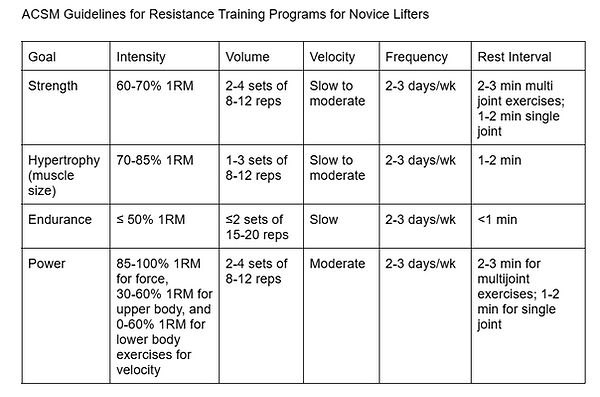
Training program design is highly specific to the individual’s needs, and by all accounts is as much an art as a science. But most people who know what they’re doing will follow something along the lines of the tables you see below.
These specific guidelines are taken directly from one of my college textbooks (Heyward 183; see bottom of article). This is not absolute dogma, but you won’t go wrong using it.


Explanations
Intensity, measured by “1RM”: 1RM refers to the amount of weight you could lift one time with proper form. The “intensity”, or heaviness of the weight, is measured by its percentage of the weight you could lift only once. So, say your 1RM for a lift was 50kg- 50% of your 1RM would be 25kg.
Repetitions: The number of times you lift the weight up and down before taking a break.
Sets: The total number of times you repeat your given number of reps.
***Typically, the overall strategy is to increase the reps up to the recommended limit, then increase the weight and decrease the reps. Of course, it can get more complicated than this for more advanced forms of training.
Common Myths
Myth: Strength training makes you “muscle bound” and slow, and is detrimental to some types of athletic performance
Fact: All aspects of performance can be improved by strength training, but you must do the appropriate kind.
Myth: Only athletes need to do it
Fact: Strength training reduces blood lipids, blood pressure, increases insulin sensitivity and glucose tolerance, reduces resting heart rate, increases bone mass, among many other things. It also can mitigate muscular imbalances in nonathletes that can lead to injury, as well as improve balance and co ordination.
Myth: Muscles Grow While You Are In The Gym Lifting
Fact: Muscles grow during recovery.
–Part of this misconception is due to “pump”, aka your muscles looking temporarily bigger and more defined after a workout due to increased blood flow.
–Protein breakdown is high during and immediately following the workout, but protein synthesis is elevated for up to 24-48 hours following the workout, or while you’re recovering.
-Consistent training inducing a pattern of breakdown and synthesis leads to greater net protein deposition
Myth: Strength training increases blood pressure and is bad for your heart
Fact: There is overwhelming evidence to the contrary. Strength training actually strengthens your heart and helps it to tolerate higher levels of stress.
-Your blood pressure does increase during a workout, but your body adapts to tolerate this. Your resting blood pressure will not increase.
–However, overtraining and abuse of anabolics are known to increase resting blood pressure.
Myth: Strength training will make your muscles continuously get bigger
Fact: Continued increases in muscle size, or hypertrophy, requires strategic training and nutrition.
Myth: You start losing gains as soon as you miss the gym
Fact: It takes several weeks to actually start losing muscle mass; before that is neural stuff and loss of pump.
-How fast you lose muscle mass if not training depends on what you’re eating and what you’re doing. If you are still physically active and getting enough protein, you can get away with upwards of a month without losing a meaningful amount of progress. (But you will probably be a bit sore the first few workouts back!)
Myth: Flexibility is mostly genetic; you can’t train it much
Fact: Genetics contributes, but you can still improve your flexibility with consistent training
Myth: Strength training will make you “muscle bound” and less flexible
Fact: Only if you don’t stretch at all. Performed properly and combined with an appropriate mobility routine, it will likely improve your flexibility.
If you have a truly extreme amount of hypertrophy, that might also make you less flexible. But your muscles must be cartoonishly big for this to happen.
Myth: You must perform every set to failure
Fact: This limits performance of consecutive sets, which ultimately hampers progress.
-At certain points in the training cycle, performing a few sets to failure will help with endurance, but that’s it.
Myth: Strength training is very risky for your joints
Fact: For the most part, this is not the case if you know what you’re doing.
-Extremely advanced powerlifting and similar sports do carry increased risk.
-Steroid abuse can also elevate risk of joint injury, because it can become difficult for your tendons to keep up with your muscles.
Citations
Clark, Micheal, et al. NASM Essentials of Personal Fitness Training. Burlington, Ma, Jones & Bartlett Learning, 2014.
Heyward, Vivian H. Advanced Fitness Assessment Exercise Prescription. Champaign, Ill. Human Kinetics, 2010.
Ratamess, Nicholas. ACSM’s Foundations of Strength Training and Conditioning. Lippincott Williams & Wilkins, 15 Mar. 2021.

